Some projects stand out — and this is one of them.
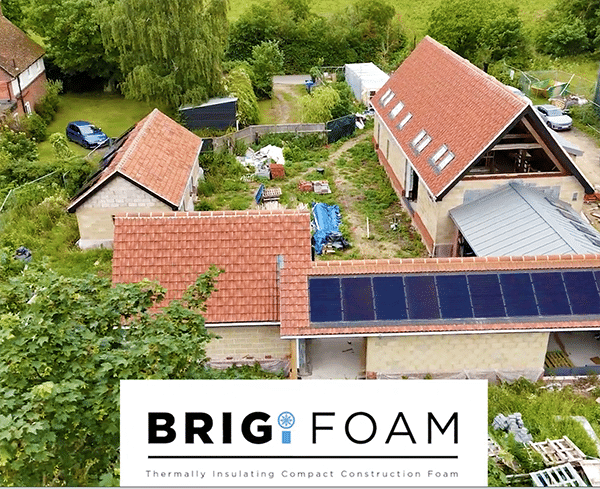
We recently had the privilege of supplying materials to a remarkable self-build project: a 16th-century barn being carefully restored using its original timbers and transformed into a high-performance, low-energy family home targeting near Passive House standards.
It’s exactly the kind of project that reminds us why getting the details right matters so much.
The challenge: Heritage meets high performance.
Bringing a centuries-old agricultural building up to near Passive House standards is no small undertaking. The very features that make a historic barn worth preserving — original timber frames, non-standard openings and irregular dimensions throughout — are the same features that make achieving modern energy performance targets genuinely difficult.
Every door opening, every window junction and every connection between old fabric and new insulation is an opportunity for heat loss if it isn’t detailed correctly. In a building with non-standard shapes throughout, standard off-the-shelf solutions simply don’t cut it.
What Lynvale supplied
For this project, we supplied bespoke structural insulation — BRIGi Foam — cut and converted at our UK factory to create effective thermal breaks around the door and window openings throughout the barn complex.
Critically, the junction details were supported by calculated thermal junction Y-values, helping to demonstrate that the proposed details could meet the thermal performance required by the project. When you’re chasing near Passive House performance in a 16th-century structure, approximations aren’t good enough — the numbers need to stack up.
Why bespoke matters in heritage renovation
Off-the-shelf insulation products are designed around standard construction. Heritage renovation rarely is. Irregular reveals, varying wall thicknesses and non-rectangular openings mean that achieving a consistent, unbroken thermal envelope requires materials that are cut and specified for the actual building — not adapted from something designed for a modern timber frame.
That’s something Lynvale is set up to deliver. Our UK factory converts materials to order, which means bespoke sizes and shapes are part of the service rather than an exception to it.
The bigger picture
There’s something genuinely satisfying about a project like this. The original timbers of a 16th-century barn will be preserved for future generations, while the family living in it will benefit from a warm, low-energy home that performs to modern standards. Historic fabric and high performance don’t have to be in conflict.
If you’re working on a self-build, heritage renovation or retrofit project and need advice on thermal bridging or high-performance insulation solutions, get in touch with the Lynvale team. No project is too complex or too unusual — that’s rather the point.
