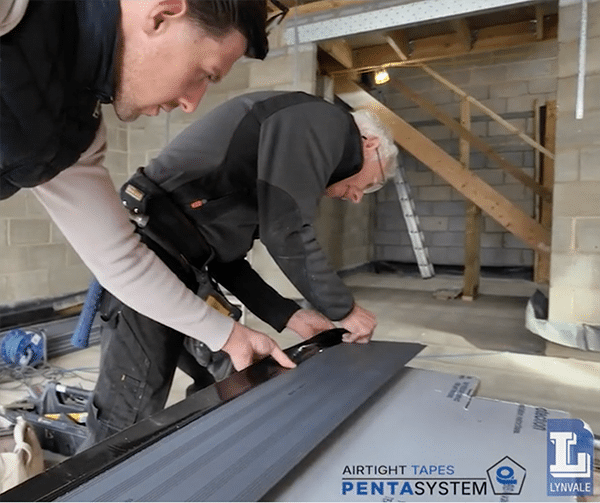
Achieving good airtightness depends as much on installation and detailing as it does on product selection. We recently visited Richard and the team at Neve Builders to provide practical, hands-on training on sealing around cavity closers and other critical junctions within the building envelope.
The session focused on the correct application of our multi-functional airtight sealing tape, giving the team an opportunity to practise the detailing techniques required to create continuous and durable seals in real site conditions.
Airtight Sealing Around Cavity Closers
Cavity closers form an important part of the junction between window and door openings and the surrounding wall construction. Maintaining continuity of the airtight layer around these interfaces requires careful detailing, particularly at corners, transitions and changes in substrate.
During the training, Lynvale Technical Manager Ben demonstrated how the tape can be applied around these more challenging details while maintaining a continuous seal.
Why a Split-Back Liner Helps Installation
A key feature demonstrated during the session was the tape’s split-back release liner. Rather than removing the complete liner at once, each section can be removed independently, allowing one part of the tape to be positioned and bonded before the remaining section is applied.
This can make the tape easier to position accurately around detailed junctions and helps installers maintain control during application.
Practical benefits include:
- One section can be positioned and bonded before the second liner is removed
- Greater control around corners, transitions and detailed junctions
- Easier positioning when creating a continuous airtight connection
- Reduced risk of the adhesive prematurely contacting the wrong surface during installation
- Faster and more controlled application on complex details
Performance at the Junction
The multi-functional sealing tape used during the training offers W1 water resistance and a typical Sd value of 15 m, supporting its use as part of a carefully detailed window, door and cavity-closer sealing strategy.
These characteristics allow the tape to contribute to weather protection and controlled vapour resistance while maintaining continuity across critical building-envelope junctions.
Understanding the Complete Building-Envelope Detail
Sealing around cavity closers is not simply about applying tape to a joint. The connection needs to be considered as part of the wider building envelope, including airtightness, thermal continuity and moisture management.
Correct detailing can help minimise unintended air leakage and maintain continuity between adjacent components, supporting the intended thermal performance of the junction.
Where the construction requires more advanced moisture management, Lynvale can also provide humidity-variable membranes and associated sealing tapes designed to form part of an appropriate building-envelope strategy.
Practical Airtightness Training on Site
The Neve Builders team were able to practise the application techniques themselves and work through the types of junctions encountered during the project.
Hands-on training provides an opportunity to move beyond product specifications and demonstrate how materials should actually be handled, positioned and connected on site. It also allows installers to discuss difficult details before they become recurring problems across a project.
Thank you to Richard and the Neve Builders team for welcoming us to the project and putting the sealing system through its paces in real site conditions.
Support for Your Next Project
Lynvale provides practical product demonstrations, installation guidance and training for contractors and project teams working on new-build and retrofit projects.
If you would like to arrange an on-site demonstration, training session or discuss suitable airtightness products for a particular building-envelope detail, contact the Lynvale team.
